

How Employers Shape Disability Advocacy: Stories from Employees
Introduction
Disability advocacy in the workplace is an important topic that can also be emotionally charged for those who choose to self-advocate. Sydney Elaine Butler (Accessible Creates) and Erica Carson-Sami (CARCO Disability Strategies) have partnered with Whimble to collect insights from the disability community about journeys to self-advocacy in the workplace by administering a survey. An analysis of the survey results showed that employees face an emotional toll when advocating for themselves in the workplace, and that employers play a vital role in shaping the emotional impact and the process itself.
What is Disability Advocacy in the workplace
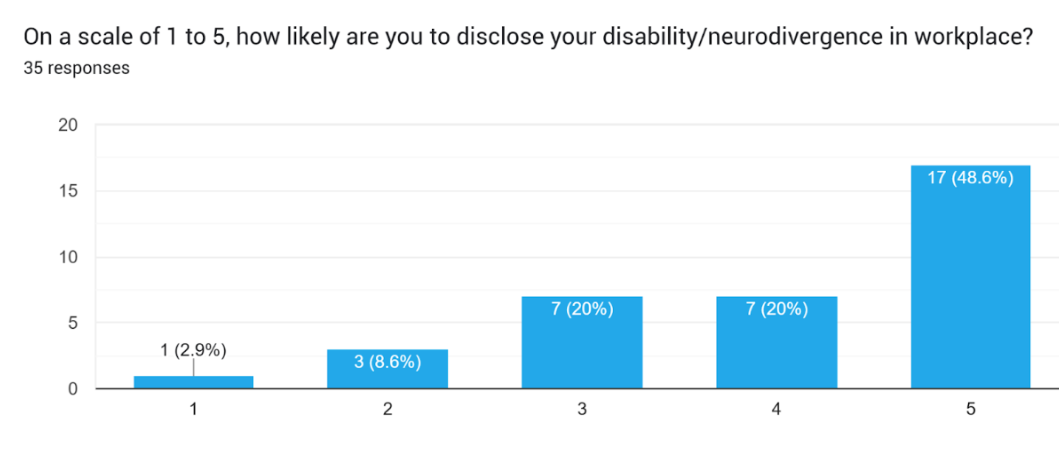
48.6% of the survey said they would disclose their disability or neurodivergence in the workplace. There is a common misconception amongst employers that disability advocacy looks like favouritism. One respondent stated, “I was told to keep it quiet because it would look like favouritism and [could] create unrest on the team”. Initially, employees thought that it would help them be provided with accommodation and support from their employers. Disability advocacy in the workplace looks different for everyone. For some, it may be people with disabilities advocating for themselves; for others, it may involve getting support from their employers (managers, supervisors, human resources, and even team members) to advocate on their behalf. It is intended to help employees understand and secure their rights for fair treatment and necessary accommodations, fighting barriers like ableism to ensure inclusion. We heard stories that highlight the harsh reality of this type of advocacy in the workplace and the often pushback or lack of understanding of the courage and emotional toll it can take to disclose or request accommodation. This is a direct result of employers not understanding the power they hold in impacting someone’s ability to have the tools and support that the employee needs to succeed and feel included in the workplace.
Employers' Role in Disability Advocacy in the Workplace
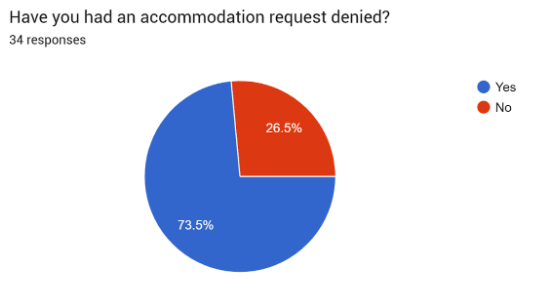
73.5% of our respondents have had accommodation requests denied. This is very telling of the employers’ role in disability advocacy and how it impacts their employees. It is the role of employers, including managers, supervisors, and human resources, to provide accommodation to employees to the point of undue hardship. While there is no clear definition of undue hardship, it occurs when required accommodation measures would be prohibitively expensive or create undue risks to health or safety. This is where the duty to accommodate ends. However, each situation needs to be addressed on a case-by-case basis. In response to the question, “Have you ever had issues with receiving your requested accommodations at work? What happened?” one respondent stated, “Yes, [I] met with occ[upational] health and was told at one place it is undue hardship”. The respondent should have been provided clear reasons why it was undue hardship, and not just told that it was undue hardship; it should have been conveyed whether it was due to cost or due to risk regarding health and safety. The lack of explanation can lead to doubt, lack of confidence and so forth. Whereas the employer risks legal consequences and their reputation.
Tips
Tip #1: Establishing clear accommodation processes through policy and procedures:
“One manager made it a non-issue from the get-go and treated accessibility as common as ordering supplies. It made the process so empowering”. This statement from the survey responses highlights how straightforward and impactful accommodation processes can be. Accommodation policies and procedures should include the following to ensure the process can be simple and consistent.
Tip #2: Provide leadership with resources such as toolkits, training, and access to Disability Consultants and Coaches
“I think employers talk a lot about EDI and accessibility, but the reality is they are more interested in equality than equity.” Fairness (equity) requires a more reflective and intrusive look at the organization’s policies and procedures, and requires providing leadership with rich resources. Whereas sameness (equality) is a much easier process. Therefore, providing leadership with resources for disability inclusion involves deploying tailored toolkits, specialized training, and access to expert consultants to foster a truly accessible, equitable, and confident workplace.
Tip #3: Listen to disabled employees within your organization, and do this by having a Disability Employee Resource Group (ERG)
“As a woman of colour with a physical disability, I need to advocate for myself significantly compared with a white woman on my team who also lives with cerebral palsy. She seems to get all of her accommodations without a doctor’s note, while I am forced to provide medical notes biannually to maintain my accommodations. I also noticed that the team bends over backward to accommodate her sensory-related disabilities, while my invisible disabilities are questioned. Thankfully, I go to therapy on a biweekly basis to learn how to stand up for myself.” This respondent shared a story that we know occurs across various organizations. All disabled employees deserve to be listened to within an organization. As an employer, it is your duty to accommodate employees regardless of race. By having a Disability Employee Resource Group (ERG), this will allow all employees to come together to share their concerns and ideas to promote and foster disability inclusion in their organizations, and notice where there are issues, and create pathways to better express these issues and ideas to the employer.
Conclusion
Accommodation, disclosure, and disability advocacy are not just buzzwords but important words and actions that greatly impact the lives of people with disabilities. As an employer, it is important to understand how you approach and handle these actions impacts someone’s life in such real ways. Based on our analysis of the survey, it highlighted how negatively or positively supervisors, managers, and human resources respond to these situations has a direct impact on the employees’ mental health. You (the employer) must understand the importance of using your position to help support, reasonably accommodate and handle disclosure of your employees with disabilities, not just with the correct legality, but with the human care that is needed.
✨Connect
📲 Follow us on Instagram to stay updated on the next blog post.
🤝 Get in touch with the writers here and here.
